The
Artist and the Studio
Owner / Artisan / Designer/
Consultant
|
|
|
 |
|
Yulokod
Studios is located in Cambridge, Ontario, Canada. It is a single
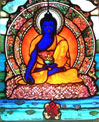
artist studio dedicated to the craft of hand-painted stained glass,
Thangkas and Buddhist iconography. as well as preservation and
Restoration of sacred imagery in painted glass.
The resident artist and founder is Ani Thubten Jamyang Donma,
known simply as ani J. |
Before
taking ordination as a Buddhist nun, she was known as Catherine
A. Brock. Her relationship with glass painting began with her
training in ecclesiastical traditional glass painting in Toronto,
Canada at the renowned glass studio Robert McCausland Ltd. Founded
in 1856, this studio is Canada’s pre-eminent Ecclesiastical
glass studio. Catherine apprenticed there for some 7 years restoring
and creating windows for sacred spaces which included churches,
synagogues, government buildings, mausoleums, universities and
private shrines.
She
was very fortunate to have the opportunity to train with some
of the greatest masters of glass painting. Catherine studied
and painted alongside master glass painters who had been painting
for over 50 years. This is a dying art form and the rare opportunity
of even meeting some of these masters, let alone apprenticing
with them was a very auspicious and a rare and precious opportunity.
It was several years later that Catherine established her own
studio and a successful retail shop on Toronto’s Yonge
Street “Ondine Art Glass.” After several years of
intense creativity and service to the community through her
glasswork she awoke to her spiritual potential.
|
|
|
|
|
It
was a rainy day in Mandi
|
| |
| |
|
|
| |
Ven. Khenpo Sonam
Tobgyal Rinpoche welcoming H.H. Penor Rinpoche & Garchen Rinpoche
to Riwoche Temple, Toronto
|
|
|
|
| |
|
In
1989 Catherine met her root teacher Venerable Khenpo Sonam Tobgyal
Rinpoche of the famed Riwoche of Kham, Tibet, and assisted Venerable
Khenpo Sonam Tobgyal Rinpoche to establish Riwoche Temple in Toronto,
Canada.
She took ordination as a Buddhist nun first in 1994 with Khandro
Rinpoche, and again with His Holiness Penor Rinpoche, Khenpo Tsewang
Gyatso and 13 Khenpos of the Palyul Lineage in 1997. She was bestowed
the name Ani Thubten Jamyang Donma, she has come to be known simply
as Ani J.
|
|
|
|
| Ani J. had the
great fortune to take many teachings , empowerments, retreats and
precepts with: His Holiness the Dalai Lama, Kyabje Nyoshul Khen
Rinpoche, His Holiness Penor Rinpoche, Dungstse Thinley Norbu Rinpoche,
His Holiness Sakya Trizin, His Holiness Chetsang Rinpoche, His Holiness,
Tai Situ Pa Rinpoche, His Eminence Chokling Rinpoche, Kyabje Phakchok
Rinpoche, Garchen Rinpoche,Khenpo Sonam Tobgyal Rinpoche, Khenchen
Palden Sherab , Khenpo Tsewang Dongyal , Khenchen Tsewang Gyatso,
Jetsun Kushok, Khandro Rinpoche, Ven Dhyani Ywahoo and Venerable
Jetsunmma Tenzin Palmo.
Ani J recalls
“It was Kyabje Nyoshul Khen Rinpoche that pointed me on my
path when he stated” Even working with glass and creating
works of beauty is a Bodhisattva Path if done with Pure View’.
|
|
| |
|
Ven.
Khenpo Sonam Rinpoche with Kyabje Nyoshul Khen Rinpoche
|
|
|
| Ani
J states “From the very first time I ever saw a Tibetan Buddhist
Thangkas I had the aspiration to work with this art form and to
work with the illumination of stained glass. All through my training
and studies I persevered in the study of the Tibetan Thangkas. |
|
| |
|
Riwoche
Temple, Toronto, Ontario, Canada
|
|
|
| |
| The
original Riwoche Temple in Kham, Tibet was renowned for its art.
Ven, Khenpo Sonam Tobgyal Rinpoche was very inspired and committed
to create in Toronto, Canada as authentic a temple as he could based
on the correct traditional methods and their application and to
re-create the Riwoche,Tibet Shrine in Toronto, Ontario, Canada.
(link here: http://www.riwoche.com/
)
Ani
J. States” So it was my great fortune to have him as my root
teacher not only for his pristine instruction in Dharma but also
being present as he brought many great artists to come and stay
for extended periods of time in Toronto, Canada to re-create the
shrine as it had been in Tibet before the Communist invasion.
Through
this experience I met many great Thangka Painters: Lopon Konchog
Lhadrepa and Urgyen Gyalpo from Tsering Art School in Nepal (founded
by His Holiness Dilgo Khyentse Rinpoche and Rabjam Rinpoche Link:
http://tseringschool.org/
and http://ugyalpo.wordpress.com/
)
|
|
| |
|
Urgyen
Gyalpo with his teacher Lopon Konchog Lhadrepa of Tsering Art School,
Nepal
|
|
|
| |
| I
also met and learned much from the great Bhutanese Sculptor Tsewang
Dorje, as well as the gifted Canadian artist Chris Banigan who introduced
me to the use of computer graphics as a useful tool and method for
perfecting the images. These great artists along with Venerable
Khenpo Sonam Tobgyal Rinpoche instilled in me the understanding
of sacred measurement and its necessity for correct Buddhist iconography
as well as some understanding of the different schools and styles
of Thangka painting. They also gifted me with many great reference
materials to guide my work. I often call upon them for clarification
and validation as to correct representation of the images when they
are first drawn up, to make sure that they are absolutely correct,
as well as referring to the traditional manuals that they bestowed
upon me |
|
| |

" Drawing for
a Stained Glass Thangka portraying Saraha the Great Mahadiddha
for my Guru Kyabje Phakchok Rinpoche
|

Kyabje Phakchok
Rinpoche
|
| |
| Once
the drawings are rendered and translated to the stained glass medium
they are often approved and corrected by the traditional Thangka
painters and then finally the patron. From the completion and approval
of the drawing each piece of glass is cut, ground to perfect shape
and hand painted with glass enamels, glazes and shaded for a true
three dimensional effect. Some of the pieces are painted and fired
as many as five times. The glass is then wrapped in copper and zinc
and soldered to form a solid, strong flat panel to be hung in the
light, to last for many generations... |
|
|
| “Working
with the light and the actual minerals that not only produce pure
color but also have the healing qualities and vibration is very
profound and important. I believe it takes the Buddhist iconography
to yet another level and allows the viewer to have a more direct
experience thru the light. This is how the iconography was originally
intended with a non-corporeal body of light and the result is nothing
short of wonderment... |
|
| |
|
|
| |
FYI:
These works of art in stained glass do take quite some time to complete
average wait from start to finish is 2 to 2.5 years, but are well
worth the wait. This includes the drawings and concept as well as
creation of the window and takes into consideration the great care
I take in making the windows as well as the patrons who are already
in the queue.
This is a single artist studio. |
|
| |
| |
|
|
|
| |
|
Thank
You for taking the time to visit my website,
May you Be Well and Happy................
|
| |